
‼️ Bots Targeted Taylor Swift—Are You at Risk Now, Too?
Protecting yourself and your business from this type of attack

Summary: In this post I explain the recent Taylor Swift disinformation attack and use it as a case study for the rest of us. I also explain the steps you can take to protect your business and reputation.
I’m not a card-carrying Swiftie, but like the most of us, I somehow know the words to many of Taylor Swift’s songs and find my toe tapping when one comes on the radio.
I know about her most recent album, Life of a Showgirl, which was Spotify’s most pre-saved album ever (6 million), and it sold 2.7 million copies on launch day (physical + digital), making it the top-selling album of 2025 in just a single day. 🤯
Because of my job in digital marketing, I am on social media probably more than most people, so I could not help but witness an almost immediate vicious backlash against Taylor: angry fans claiming her album merchandise contained hidden Nazi imagery, screenshots that “proved” she was tied to extremist politics, and all sorts of wild claims about coded dog whistles in her song lyrics and harmful messages in her visuals.
It was a weird, unexpected, and over-the-top social media movement. As a result, “Taylor Swift” trended for weeks, not for her actual music, but for the negative controversy surrounding it.
While Taylor and her team did not acknowledged the accusations, the Swiftie Army rose like a collective fierce Mama Bear to respond to every post and deny every rumor.
‼️ But here’s what we now know… none of it was real.
News broke this week in Rolling Stone that Taylor Swift was hit by a coordinated, purposeful disinformation campaign — a network of online accounts were pushing these extremist associations about Taylor, and they were completely fake accounts. Cybersecurity analysts have now traced the activity to bad operators using bot-like behavior to spread this harmful narrative about her.
In other words: it wasn’t Taylor’s actual fans getting upset and turning on her as it originally seemed; instead, it was an organized attempt by bots to tear down a pop superstar.
👉 Read more for yourself: Taylor Swift’s Last Album Sparked Bizarre Accusations of Nazism. It Was a Coordinated Attack
😵💫 What the Attack Teaches the Rest of Us
Whether you care about Taylor Swift or not, the real danger is how easily the next target might be a nonprofit, a business, or even you.
Taylor did not sign up to become a case study in AI-era disinformation, but here we are. What happened to her wasn’t really about politics or music. It was a proof of concept for how easy it is in the age of AI to hijack public attention, distort reality, and manufacture fake outrage when assisted by bots manipulating the algorithm.
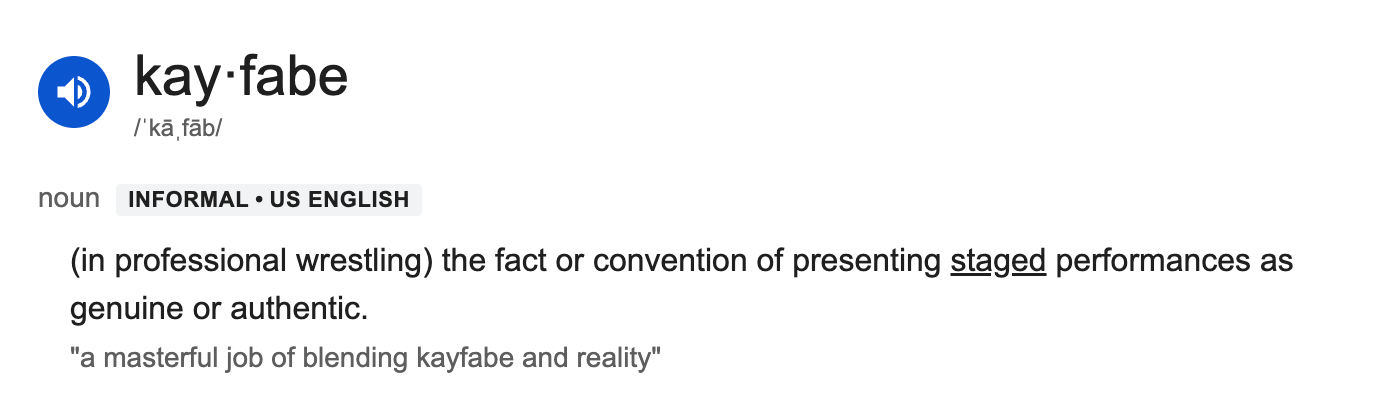
As my cousin Pierce would say, this was actually a form of kayfabe played out in realtime across social media.
This was a stress test on the internet itself — and what did this prove for the bad actors that coordinated the smear campaign? It provided a strong proof of concept, so we can be sure we’ll seeing this type of attack again.
🤖 A Few Bots Can Create the Illusion of a Movement
Let’s call this what it is: reality, hacked.
A small group of fake or bot accounts managed to push a narrative so forcefully that it hit mainstream discourse. No real evidence, no true scandal — just repetition, amplification, and timing.
This is the new formula for kayfabe: Create a handful of accounts. Generate content with AI. Program automated bots to repeat a lie until the algorithm thinks it’s trending. Then let real people pick it up, argue about it, and carry it the rest of the way.
Imagine what this could do to:
a political candidate
a startup
an estbalished brand
a nonprofit fundraiser
a local business
a school teacher
a community event
A rising athlete
And most of these people do not have Taylor Swift’s PR team or her army of fans to counter ther narrative.
❌ So What Is the Actual Danger?
Most targets won’t know they’re under attack until after the damage is done and social media (and possibly mainstream media) is already flooded with the false narrative.
By the time a brand, nonprofit, public figure, or regular person realizes something is happening, that narrative may already be out in the world — screenshotted, reposted, and believed by people who will never see your attempts at a correction.
We’ve seen smear campaigns before, of course, but the Taylor Swift attack was at scale, proving bots can create tsunami unlike anything we’ve seen up to this point.
✅ So What Can Organizations Do to Protect Themselves?
The scary truth is that most disinformation attacks don’t look like “attacks” at first. They look like odd comments, out-of-nowhere rumors, or a sudden spike in strange engagement. By the time it feels serious, the narrative may already be spreading.
But there are steps organizations can take — not to eliminate the threat entirely (no one can, not even the Swiftie Army!), but to try and reduce the damage and mount an alternative response.
Here’s the advice I’d give any brand or nonprofit waking up in the AI era:
1. Monitor your digital footprint like it’s part of your infrastructure.
Treat online reputation the same way you treat cybersecurity or accounting. It’s not optional anymore. This means:
Setting up social “listening” tools
Tracking sudden changes in the way people talk about your brand online
Flagging unusual spikes in comments or mentions
Keeping an eye on Reddit, TikTok, Threads, and other places where narratives can spread quietly
NOTE: Even if your brand is not active on a social media network, you still must be listening to how people are talking about you there. You can’t fight what you can’t see!
2. Establish a rapid-response communication plan before you need one.
Don’t create your crisis plan *during* the crisis. Have it ready now.
A good plan includes:
Which person is responsible for monitoring the situation and mounting the response:
Who has the final say on whether to respond or stay silent?
What tone, format, and platform will you use if you do respond?
How and when will key members of your organization be notified?
Who will communicate internal directions about publicly commenting?
Create a plan of action now for those “first 24 hours” and beyond
For most organizations, clarity and speed are your best tools.
3. Build a loyal, informed community long before trouble hits.
Your best defense is people who already trust you. We all need a Swiftie Army of sorts!
When a false narrative appears, your supporters can work on your behalf by:
Denying and correcting misinformation
Drowning out bad actors
Bringing the conversation back to a narrative you own
This is exactly what the Swifties did. Organizations need their own version of that— a community that knows your mission and valuesso well they can easily defend you.
👉 Read more about building such a community in my book: Unio: The Art of Intentional Community Building
4. Stay transparent and human when addressing real concerns.
If a rumor does gain traction or confuses your audience, you don’t need to deliver a dramatic statement — just a calm, factual clarification.
Something like:
“We’re aware of misinformation circulating online. This claim isn’t accurate. Here’s the truth, and here’s what we’re doing.”
Clear and concise. No defensive energy, no panic. People don’t expect perfection, but they do expect honesty.
5. Train your team to recognize disinformation patterns.
Staff, volunteers, board members — everyone should know the basics:
What fake screenshots look like
How coordinated bot behavior works
How to avoid accidentally amplifying a false claim by arguing with the bots
When to escalate something internally to the correct person in your organization
NOTE: This is yet another reason you don’t make a high school student or college intern the one directing your socials. 😉
6. Document everything.
Screenshots, timestamps, URLs — keep a record of that misinformation. This becomes essential for reporting the behavior to platforms. You can then demonstrate a pattern and coordination by a network of bad actors.
This also protects your organization legally and reputationally. (Not sure that’s an actual word, but you get what I mean!)
7. Strengthen your digital identity before someone impersonates it.
This may sound basic, but many organizations overlook this. Secure your:
Social media handles
Domain variations
Email addresses
Staff accounts
Admin permissions
Networks and accounts with 2-step security
Many smear campaigns begin with impersonation — fake accounts pretending to “speak” as your organization, so be sure claim your digital real estate before someone else does.
Again this is where screenshot and reporting to platforms is paramount to have the bad actors rmoved.
8. Know when silence is powerful and when it is harmful.
Here’s the nuance that you as the organization will have to determine:
If the rumor is fringe and obviously false: silence often prevents oxygen from reaching it. (Don’t spend time arguing online, which will only fuel the fire.)
But if the rumor is confusing the people you serve: speak. Quickly, clearly, calmly.
The goal is not to “fight the trolls” but rather to reassure your real audience.
9. Treat disinformation as a long-term risk, not a one-time problem.
This is not going away. It will become more common, more sophisticated, and more harmful.
Organizations that thrive will be the ones who stay vigilant, educated, and respond from a place of strategy rather than fear.
You can’t stop people from lying online. You can build an organization strong enough so a malicious set of lies can’t redefine you.
Surviving the robot future belongs to the resilient, not the reactive, and as I always say, we’re stronger together, friends. Let’s watch out for each other!
Disclosure: This week is all me and I am a terrible proofreader, so please excuse the typos!